
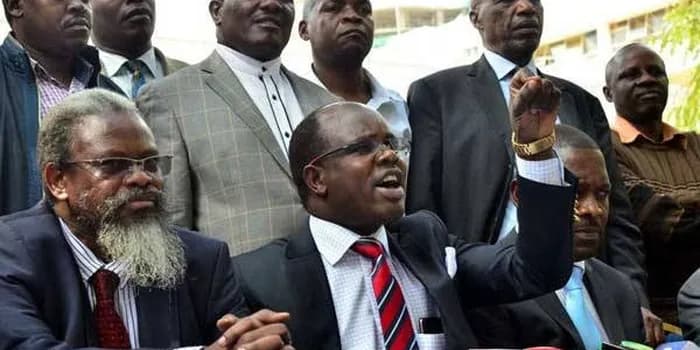
Kenya’s universities may finally be approaching the end of an academic paralysis that has left students stranded, semesters uncertain and the country’s higher-education establishment looking distinctly uncomfortable. After weeks of confrontation, the government and university lecturers have reached a reported Sh20 billion agreement that could bring the nationwide strike to an end.
The breakthrough, announced by Universities Academic Staff Union (UASU) Secretary-General Constantine Wasonga on Wednesday, offers a reprieve to thousands of students whose academic lives have been suspended in the peculiar limbo of university strikes: enrolled, technically learning, but denied the ordinary business of attending lectures.
The agreement is expected to be formalised on Friday, October 30, with the union indicating that it intends to call off the strike at 3pm. If the arrangements proceed as announced, teaching could resume on Monday, November 2. But until the terms are documented and the industrial action formally terminated, relief remains an expectation rather than a settled fact.
The money is the centrepiece of the settlement. The Sh20 billion package is intended to cover basic salaries and allowances under the 2025–2029 collective bargaining agreement (CBA), following negotiations involving Education Cabinet Secretary Julius Ogamba, National Treasury Cabinet Secretary John Mbadi and Interior Principal Secretary Raymond Omollo.
Wasonga was keen to establish that the union had negotiated the figure rather than merely accepted a government prescription. That distinction matters. Collective bargaining is not a ceremonial exercise in which the employer announces what it can spare and the employee learns to be grateful. It is a contest over the value of labour, the dignity of professionals and the resources a state is prepared to commit to its public institutions.
From Sh9.76 billion to Sh20 billion
The road to the agreement was hardly a triumph of administrative efficiency. It was a demonstration of how expensive delay can become when negotiations are allowed to deteriorate into industrial warfare.
On October 26, the unions rejected a government counteroffer of approximately Sh11.96 billion, having previously dismissed proposals of Sh9.76 billion and Sh11.95 billion as inadequate. UASU had put its demand for the four-year agreement at Sh98 billion, exposing a yawning gulf between the workers’ expectations and the government’s financial commitments.
The eventual Sh20 billion figure represents a substantial concession by the government, although it remains far below the union’s stated demand. The final agreement must therefore answer the questions that money alone cannot settle: how much will individual lecturers receive, when will payments be made, and what guarantees exist against another round of broken promises?
For students, meanwhile, the cost of the dispute has never been confined to a negotiating table. University of Nairobi students took to the streets this week to demand an end to the impasse, illustrating the frustration of a generation whose education is already expensive and whose time is not endlessly renewable.
The government may celebrate the prospect of reopening lecture halls. UASU may claim a hard-won victory. Yet neither declaration will restore the weeks lost, erase the anxiety of students facing uncertain academic calendars or automatically repair the strained relationship between university employees and their employer.
The real test begins after the signatures. A collective bargaining agreement is worth considerably less than the paper on which it is written if its financial commitments are not honoured.
For now, Kenya’s public universities have been offered something they desperately need: a route back to normality. Whether Friday delivers a durable peace or merely an intermission before the next confrontation will depend on the fine print, the payment schedule and the government’s willingness to keep its word.
The lecturers have negotiated their way towards the classroom. The students are waiting at its door.