
There are exits, and then there are exits. Some politicians leave office through the front door, graciously defeated and dutifully congratulating their successors. Others discover, somewhere between the ballot box and the airport lounge, that the country they have just lost an election to govern is no longer safe for them.
Flávio Bolsonaro, Brazil’s defeated right-wing presidential candidate, belongs emphatically to the latter school.
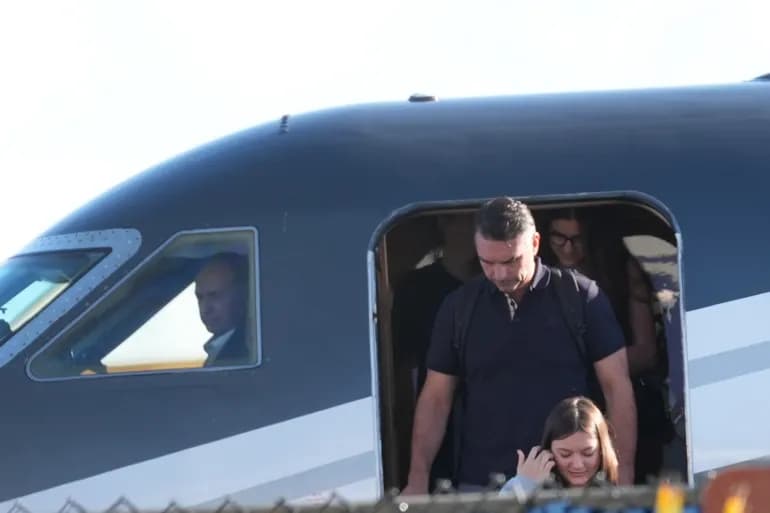
On Wednesday, the 45-year-old senator arrived in Miami with his wife and two daughters after a circuitous journey through Argentina and Ecuador. His destination was Florida; his explanation was patriotism. “I did not flee Brazil; I left for the sake of Brazil,” he declared, presenting his departure not as retreat but as a strategic manoeuvre against what he called political persecution.
It is a remarkable proposition: that a politician can lose an election, leave the country amid a criminal investigation, and emerge on foreign soil proclaiming himself the guardian of the national interest.
But Brazil has become accustomed to the Bolsonaro family’s talent for turning political reversals into spectacles of victimhood. The family drama now has a familiar setting, too. Florida, that sunlit sanctuary for displaced conservatives, has once again opened its arms to a Bolsonaro fleeing the consequences of Brazilian politics.
The journey itself was worthy of a political thriller. After missing a deadline to surrender his Brazilian passports, which were subsequently cancelled, Bolsonaro disappeared from public view. He and his family crossed into Argentina, boarded a private aircraft to Ecuador and continued to Florida. The route, verified through flight-tracking data and Argentine immigration records, offered a conspicuous geographical answer to a question Bolsonaro would rather frame as philosophical: why leave Brazil at precisely this moment?
The timing was hardly incidental. Brazil’s Supreme Court is investigating allegations of financial wrongdoing, including suspected money laundering. Bolsonaro denies wrongdoing, and an investigation is not a conviction. But the court’s passport order had made his movements a matter of public interest, while his impending loss of parliamentary immunity threatened to alter his legal circumstances.
Then there is Donald Trump, whose America has become an increasingly convenient refuge for the Bolsonaro family. The US administration approved visas for Flávio and his family, while Trump questioned Brazil’s election without presenting evidence of fraud. Asked about Bolsonaro’s declaration that he was the rightful president-elect, Trump professed reluctance to intervene, before describing the election as “very strange”.
One might admire the diplomatic delicacy. Trump welcomes the man, questions the vote that defeated him, and insists he will not get involved. Political neutrality has rarely worn such an expressive face.
Brazil’s electoral authorities confirmed the victory of incumbent Luiz Inácio Lula da Silva, who defeated Bolsonaro by more than four million votes in Sunday’s runoff. International leaders and the Organization of American States recognised the result. Bolsonaro’s own Liberal Party acknowledged the outcome, even as its presidential candidate continued to allege electoral fraud without providing evidence.
Lula called the departure shameful, arguing that Bolsonaro should have remained in Brazil to answer the allegations against him. His criticism carries an obvious partisan interest, but the underlying question is legitimate: what becomes of democratic accountability when a defeated politician can relocate abroad and conduct his domestic political struggle from a friendly foreign capital?
The family resemblance is striking. Flávio’s father, Jair Bolsonaro, also travelled to Florida after losing the 2022 election. He subsequently returned to Brazil and was convicted in a separate case involving an attempted coup. Flávio’s present circumstances are distinct, and the allegations against him must be assessed on their own merits. Still, the recurrence suggests that Florida has become more than a holiday destination in the Bolsonaro political imagination.
Flávio says he left to lead his people. Perhaps he intends to organise Brazil’s conservative opposition from abroad. Perhaps he genuinely fears political persecution. What is clear is that he has exchanged the uncertainty of Brazilian politics for the hospitality of a powerful ally.
But democracy is not a throne that can be claimed by letter from Miami. Nor does patriotism become more convincing merely because it is declared beyond the reach of one’s country’s institutions.
The ballot box has delivered its verdict. The courts must establish the facts of the investigations. And Bolsonaro, if he wishes to be regarded as Brazil’s leader, must explain why leadership required a departure that looks remarkably like flight.
In politics, the art of leaving is often mistaken for the courage to lead. Brazil may soon discover whether Flávio Bolsonaro has mastered the former while merely borrowing the language of the latter.