
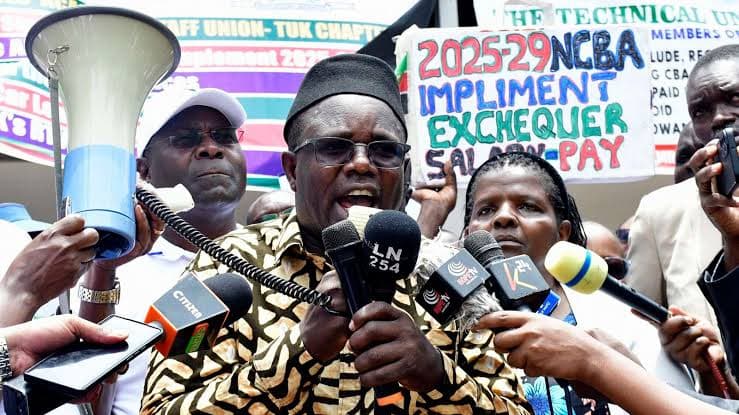
Kenya’s university strike has entered another week of paralysis, and the government’s latest attempt to buy industrial peace for Sh12 billion has met an emphatic rejection. On Monday, October 12, negotiations between the state and university staff unions collapsed for the second time in a week, leaving thousands of students suspended between an interrupted education and an uncertain future.
The spectacle is becoming depressingly familiar: government officials announce their willingness to negotiate, union leaders denounce inadequate offers, and students are left to contemplate the consequences of a dispute they did not create.
At the heart of the impasse is the 2025–2029 Collective Bargaining Agreement (CBA), whose implementation has become a test of the government’s credibility as much as a question of remuneration. The Universities Academic Staff Union (UASU) and the Kenya Universities Staff Union (KUSU) have rejected the latest offer, arguing that a lump-sum proposal cannot substitute for substantive negotiations over their demands.
UASU Secretary-General Constantine Wasonga described the government’s counteroffer as “awfully inadequate”, declaring that the unions had rejected it in total. The disagreement extends beyond the headline figure to salary increments, housing allowances, career progression and other employment benefits.
Herein lies the government’s predicament. Sh12 billion is not an inconsequential sum in a country wrestling with competing demands on the public purse. Yet the sheer size of an offer does not establish its adequacy, any more than a government’s declaration of goodwill establishes that it has honoured its obligations. Collective bargaining, after all, is not a ceremony in which one party announces a figure and the other supplies its signature.
The unions also accuse university councils, the Ministry of Education and the National Treasury of failing to honour a return-to-work formula signed on November 5, 2025. Their insistence on a negotiated settlement reflects a deeper concern: whether agreements reached with the state can be trusted to survive the passage from conference room to implementation.
The government, for its part, maintains that it has cleared arrears arising from the 2017–2021 and 2021–2025 CBAs. Education Cabinet Secretary Julius Ogamba made that claim on October 5 while urging lecturers to resume teaching. That position deserves consideration; so does the distinction between settling historical liabilities and resolving the terms of a new agreement. The two are not necessarily interchangeable.
Meanwhile, the principal casualties are students, whose academic calendars have become collateral in a contest between institutional authority and organised labour. Delayed lectures threaten examinations, graduation dates and professional plans. For students already contending with accommodation costs and the wider expense of university education, lost teaching time is hardly an abstract inconvenience.
There is an uncomfortable irony here. Universities are expected to produce the professionals, researchers and public servants upon whom Kenya’s development depends. Yet the institutions entrusted with cultivating the country’s intellectual capital cannot reliably deliver their central service while their employers and staff remain locked in recurring disputes.
The strike is therefore about more than money. It is about trust, the credibility of public commitments and the proper value attached to higher education. The government must explain how it intends to finance a settlement; the unions must remain accountable for the disruption their industrial action imposes on students. Neither side can plausibly claim that its responsibilities end at the negotiating table.
Until the parties agree on enforceable terms and a credible implementation plan, the lecture halls will remain silent. And every day that silence persists, Kenya pays a price that no Sh12 billion headline can adequately measure.