
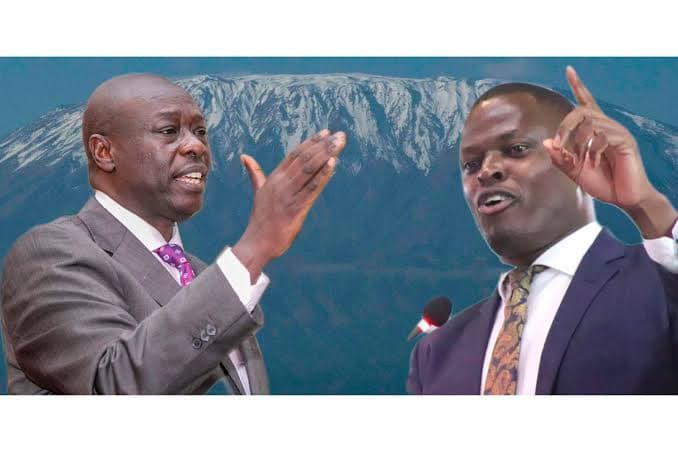
There is a peculiar irony in Kenyan politics: a region can unite to reject a president and still find itself hopelessly divided over who should inherit the rebellion. Mount Kenya, whose electoral weight helped propel William Ruto to State House in 2022, is discovering this uncomfortable truth in the increasingly acrimonious rivalry between former Deputy President Rigathi Gachagua and Kiharu MP Ndindi Nyoro.
What began as a contest over political influence has become a struggle over ownership, legitimacy and the right to speak for millions of voters who have never formally appointed either man their spokesman.
The stakes are considerable. With the 2027 General Election approaching, Gachagua has sought to consolidate the region behind his Democracy for the Citizens Party (DCP), presenting himself as the man capable of organising Mount Kenya’s disillusionment with the Kenya Kwanza administration. Nyoro, meanwhile, has established his own political platform through the People’s Party of Kenya (PPK), challenging the assumption that opposition politics in the region must pass through Gachagua’s political gatehouse.
The exchanges have hardly been a masterclass in opposition solidarity. Gachagua has warned of a political vehicle allegedly designed to confuse Mount Kenya voters, while his allies have repeatedly questioned Nyoro’s independence and intentions. Nyoro has rejected allegations that he is a government project and challenged his critics to confront him directly rather than employ insinuation.
The language of political treachery is especially revealing. To label a rival a government mole is to suggest that disagreement is not merely disagreement but sabotage. It is an ingenious instrument of political exclusion: the opponent need not be defeated on policy, popularity or organisation if his very presence can be presented as evidence of conspiracy.
Yet Nyoro’s emergence raises a legitimate question. Must opposition unity require political uniformity? A movement that demands democracy nationally but tolerates no competition within its own strongholds risks reproducing the very habits of domination it claims to oppose.
Gachagua, for his part, has a formidable argument to make. His break with Ruto has given him a platform from which to mobilise voters dissatisfied with the administration, and his political machinery offers a ready-made vehicle for that discontent. But commanding an audience is not the same as owning it. The Mountain has repeatedly demonstrated that its political loyalties are transactional, responsive to perceived interests and capable of shifting when yesterday’s champion becomes tomorrow’s inconvenience.
Nor is Nyoro’s position without complications. His previous association with Ruto, including his conspicuous role in the President’s political camp, gives his critics material for suspicion. But suspicion is not proof. His decision to establish an independent political vehicle may represent ambition, strategic calculation or a genuine attempt to widen the opposition’s appeal. Voters, rather than rival politicians, must ultimately determine which interpretation deserves their confidence.
The larger danger is arithmetic disguised as principle. If Mount Kenya’s political elite splinters into rival camps, the opposition could surrender valuable bargaining power before a presidential candidate is even selected. Conversely, forcing every ambitious politician into one camp without a credible mechanism for negotiating leadership could manufacture unity in public while deepening resentment beneath the surface.
The question, therefore, is not simply whether Gachagua can contain Nyoro or whether Nyoro can outmanoeuvre Gachagua. It is whether either man can build a political coalition broad enough to accommodate competition without confusing dissent with betrayal.
Mount Kenya does not need another self-appointed political king. It needs leaders capable of persuading voters that their interests extend beyond the fortunes of individual politicians.
The Mountain’s throne may be contested, but its electorate is not hereditary property. In 2027, the final coronation will take place at the ballot box.