
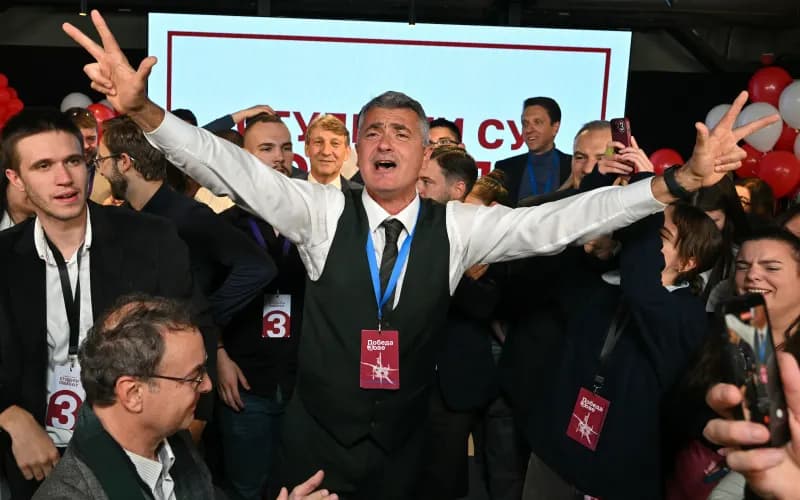
For nearly two years, Serbia’s students have been doing something that opposition politicians across the world might regard as an impertinence: refusing to go home. On Sunday, 25 October, their persistence delivered a political earthquake. Aleksandar Vučić, the nationalist populist who had dominated Serbian politics for more than a decade, conceded defeat in parliamentary elections to a student-backed movement promising to restore justice, dignity and democratic accountability.
Belgrade responded with the exuberance of a city emerging from a long political winter. Cars sounded their horns, crowds flooded the streets and fireworks punctuated the night. For Vučić, whose Serbian Progressive Party had governed since 2012, the result was an extraordinary repudiation. For the students, it was the culmination of a revolt that began not with an elaborate manifesto but with a catastrophe.
In November 2024, a concrete canopy collapsed at the railway station in Novi Sad, killing 16 people. The disaster became a national indictment of a political system that protesters accused of tolerating corruption, cronyism and institutional decay. What began as demands for accountability soon grew into some of Serbia’s largest demonstrations since the fall of Slobodan Milošević in 2000.
The students understood that a collapsed roof could become a metaphor for a collapsing state. Their argument was devastatingly simple: when public projects are compromised by corruption and accountability becomes elusive, the consequences are not merely administrative. They can be fatal.
Their movement acquired strength precisely because it was not another familiar opposition party. Instead of placing students themselves at the centre of the ballot, the Students’ List backed 250 candidates drawn largely from professions including academia, medicine, agriculture and the arts. Many were political novices. Their appeal rested on the promise that public institutions should serve citizens rather than a ruling party’s network of loyalists.
Preliminary estimates suggested that the movement could secure between 135 and 140 seats in Serbia’s 250-member parliament, comfortably exceeding the 126 required for a majority. Vučić acknowledged that his political camp had lost, although official results were still pending. His concession transformed what had been an uncertain contest into a watershed moment for the Balkan nation.
The symbolism is difficult to overstate. Vučić had cultivated an image of political indispensability, presenting himself as the guarantor of stability in a region haunted by war, economic uncertainty and competing geopolitical loyalties. His supporters credit him with investment and modernisation; his critics accuse his government of concentrating power, weakening democratic checks and presiding over a climate hostile to dissent. The election has exposed the limits of that carefully constructed authority.
Yet the students’ triumph is not the end of Serbia’s political ordeal. It is the beginning of a far more exacting test.
A protest movement can unite around what it opposes. Governing requires agreement about what should replace it. The incoming parliamentary majority will have to confront allegations of corruption, rebuild public confidence in state institutions and address concerns about media freedom and the independence of oversight bodies. It must also demonstrate that its commitment to accountability extends to political opponents as well as its own supporters.
The electoral process itself warrants scrutiny. International reporting documented concerns about intimidation, voting irregularities and the safety of activists during the campaign. Independent election monitors reported problems at polling stations, including pressure on voters and failures to protect ballot secrecy. These concerns do not, by themselves, invalidate the result, but they underline the institutional weaknesses the new majority will be expected to confront.
Nor will foreign policy permit the luxury of youthful idealism untempered by strategic reality. Serbia remains caught between the European Union, its largest trading partner, Russia, a longstanding political ally and natural-gas supplier, and China, a significant investor. The new parliamentary majority will have to navigate these relationships while deciding how firmly to pursue European integration and democratic reform.
Vučić, meanwhile, blamed foreign powers for the result, portraying the election as a revolution supported by outside interests. Such accusations may rally loyalists, but they also reveal the difficulty facing leaders accustomed to treating popular opposition as a conspiracy rather than a political judgment.
Serbia’s students have demonstrated that a government can be challenged by citizens who possess neither a traditional political machine nor decades of experience in the corridors of power. They converted grief into organisation, protest into participation and moral indignation into parliamentary arithmetic.
Their victory offers no guarantee that Serbia will become the country they imagine. But it has demolished the more dispiriting assumption that entrenched political power is necessarily permanent.
The students have won the election. Now comes the harder examination: whether they can build the institutions that their protest demanded, and whether a movement born in the streets can resist becoming the very establishment it set out to replace.