
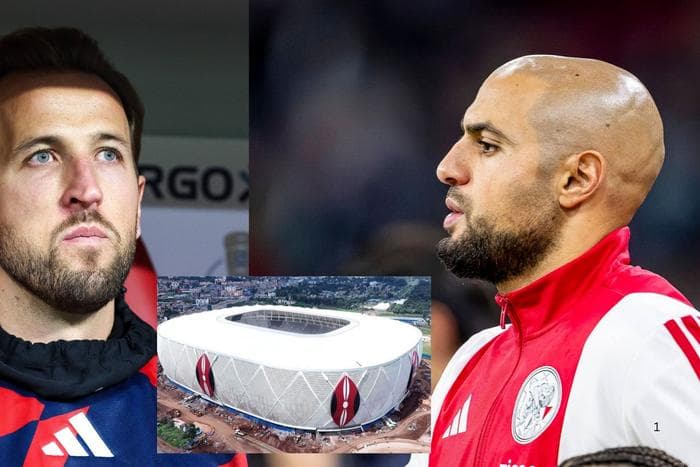
Excitement over European football royalty coming to Nairobi has collided with public anger over priorities, ticket expectations and the politics of a presidential announcement.
Kenya has secured a footballing spectacle fit for the grandest European stage, but President William Ruto may discover that the most demanding audience is not in the stands. It is online, where Kenyans have turned the planned meeting between Bayern Munich and Ajax Amsterdam into a referendum on the country’s priorities, public spending and the distance between State House and Wanjiku.
On 5 January 2027, the two European giants are scheduled to inaugurate the 60,000-seat Raila Odinga International Stadium at Talanta Sports City in Nairobi. The announcement, made by Ruto on 28 October, immediately stirred excitement among supporters who see the fixture as a declaration that Kenya is ready for the international sporting stage. Others, however, were distinctly unimpressed.
The president had promised a major announcement. What followed was a football fixture. For some Kenyans, it was a welcome revelation; for others, it was an anticlimax worthy of the internet’s merciless comedy.
Mwalimu Wanyama dismissed the announcement with the pointed observation that the president was “Not in touch with Wanjiku at all.” Samuel Nyagah offered a more immediate concern: “I thought fuel prices had gone down.” John Ngatia questioned the government’s priorities, arguing that hospitals and medicine should command greater urgency.
The complaints were revealing. Kenyans were not necessarily rejecting football or the stadium. They were asking why a sporting announcement had been elevated into a presidential moment when the pressures of daily life remained unresolved. In a country where the cost of living and access to public healthcare are recurring political concerns, the spectacle became a convenient canvas on which to paint broader frustrations.
Yet the backlash has not been universal. For football enthusiasts, the prospect of seeing two decorated European clubs on Kenyan soil is a rare opportunity rather than an extravagant distraction. Bayern and Ajax have won the European Cup and Champions League ten times between them, and the prospect of seeing stars such as Harry Kane in Nairobi has helped turn the fixture into an event of international interest. Online supporters have embraced the slogan “Kenya to the world”, celebrating what they see as a milestone for Kenyan sport.
Their enthusiasm comes with conditions. On Bayern’s social media pages, fans have demanded that the German club bring its first team rather than a collection of academy players. “Are you bringing the first team or legends?” asked Makhtoum Nelson. Another supporter warned that a weakened squad would undermine the occasion. For fans contemplating the cost of tickets, the distinction between seeing Bayern Munich and seeing its reserves is hardly trivial.
The argument has even ensnared Nyandarua Senator John Methu, who questioned whether taxpayers should finance the event. His critics responded by resurfacing footage of him watching West Ham United against Arsenal in London, accusing him of hypocrisy. Others defended his right to scrutinise public expenditure. The exchange neatly captures the contradictions of Kenyan politics, where a demand for accountability can quickly become a contest over who has the right to make it.
Meanwhile, social media influencer Mwabili Mwagodi, known as Jomba, said he had emailed Bayern and Ajax urging them to reconsider the fixture. His intervention, which attracted considerable online attention, demonstrated that opposition to the event has moved beyond sarcastic commentary into attempts to challenge the clubs’ participation. The allegations he raised against the government remain his claims, not independently established findings.
The government, for its part, says the opening will be supported through corporate partnerships and a commercially sustainable model. That assurance should be tested against published figures, not accepted as a substitute for them. The public deserves to know what the clubs will receive, who is paying, and what economic benefits Kenya expects in return.
Ultimately, the Bayern-Ajax fixture has become something larger than football. It is a test of Kenya’s sporting ambition and of its government’s ability to explain that ambition to a sceptical public. On 5 January, the stadium may be full, the shirts colourful and the atmosphere electric. But the applause will mean more if the event delivers value beyond the final whistle.
For now, Kenya is divided between those eager to witness history and those asking who will pay for it. Both questions deserve an answer.