
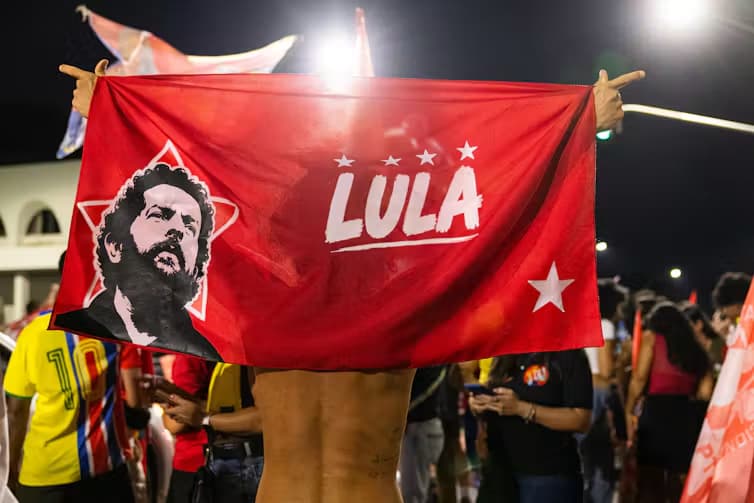
There are political defeats, and then there are defeats that refuse to behave like defeats. Luiz Inácio Lula da Silva, Brazil’s veteran left-wing president, has just delivered the latter, confounding expectations and political arithmetic to secure a fourth, non-consecutive term in office. At 80, with his 81st birthday approaching, Lula has demonstrated that political longevity is not necessarily a prelude to irrelevance. Sometimes, it is merely the prologue to another improbable comeback.
His opponent, Flávio Bolsonaro, the 45-year-old senator and son of Brazil’s imprisoned former president Jair Bolsonaro, had entered the runoff with the wind in his sails. On 4 October, he had beaten Lula in the first round, taking approximately 47 per cent of the vote against the incumbent’s 45 per cent. Yet, in the final reckoning, Lula prevailed with 51.79 per cent against Bolsonaro’s 48.21 per cent, winning by roughly 4.3 million votes. Brazilian electoral history had acquired an unusual footnote: a first-round loser had turned the tables in the second.
The result is a rebuke to the proposition that the right-wing populist tide is politically inexorable. But it is no warrant for complacency. More than 53 million Brazilians voted for Bolsonaro. The country has not suddenly rediscovered a common political vocabulary; it has merely decided, by a narrow majority, which of its competing national projects it is prepared to tolerate.
A family business called power
Flávio Bolsonaro’s candidacy was always about more than the ambitions of a senator. It was an attempt to preserve a political inheritance whose founder now sits behind bars, serving a 27-year sentence for plotting a coup after losing the 2022 election. Jair Bolsonaro’s conviction made his son’s candidacy a particularly consequential test: could a movement associated with the former president’s assault on democratic institutions survive its leader’s imprisonment by changing the name on the ballot?
For a time, the answer appeared to be yes. Flávio capitalised on anxieties about urban crime, embraced socially conservative constituencies and presented himself as an outsider despite his family’s long immersion in Brazilian politics. His campaign drew strength from evangelical networks and the digital machinery of modern political persuasion. The old man’s political brand, it seemed, could outlive the old man’s freedom.
Lula’s victory has interrupted that succession. It has not abolished the movement that made it possible.
The distinction matters. Democracy is not simply the ritual by which citizens choose their rulers; it is also the system that prevents those rulers from treating the state as a family inheritance. Bolsonaro’s defeat preserves the immediate prospect of democratic continuity. Whether Brazil can deepen that continuity will depend on institutions, political restraint and a willingness to accept electoral outcomes even when they are inconvenient.
That last requirement may prove the most difficult. Flávio Bolsonaro has refused to concede, disputing the circumstances of the vote. Such claims must be assessed against evidence, not dismissed merely because they come from a defeated candidate. But neither should allegations become a permanent substitute for proof.
The price of a second chance
Lula’s triumph was not secured by nostalgia alone. His campaign had to confront the familiar liabilities of incumbency: concerns about public security, household finances, indebtedness and the gap between economic statistics and the lived experience of ordinary Brazilians. His supporters responded with an intensive mobilisation effort, seeking to recover voters who had abstained in the first round and persuade wavering citizens that another Bolsonaro presidency carried risks they could not afford to ignore. Millions joined a WhatsApp mobilisation network, while Lula’s campaign expanded its presence on Instagram and TikTok. The veteran politician, who had only recently acquired his first smartphone, found himself competing in a political arena where attention is currency and the algorithm an increasingly consequential campaign operative.
The irony is delicious. A politician whose career began in the labour movement has had to embrace the digital instruments of contemporary politics to defend a project rooted in social welfare and economic inclusion. The old left has discovered that it cannot simply lecture the young about solidarity; it must also learn to compete for their screens.
Yet Lula inherits a formidable obstacle. Brazil’s newly elected Congress contains a powerful right-wing contingent that could frustrate his legislative ambitions. His fourth presidency will therefore require more than the rhetorical satisfaction of having defeated the Bolsonaro name. It will demand negotiation, coalition-building and tangible improvements in the lives of citizens who did not vote for him.
The environmental stakes are equally considerable. Under Lula, deforestation in the Amazon has fallen sharply, while his administration has sought to strengthen protections for Indigenous communities and confront illegal mining. A continuation of that agenda matters far beyond Brazil’s borders: the Amazon is not merely a national possession but an ecological system of global consequence. Nevertheless, environmental ambitions will compete with economic interests and a legislature not uniformly sympathetic to conservation.
A victory, not a settlement
There is also a geopolitical dimension. Lula’s victory strengthens a leader who has advocated a more independent international posture, maintaining relations with Washington while cultivating ties with China and other powers. It denies the regional right an important symbolic victory and offers democratic movements elsewhere a reminder that electoral outcomes are not always dictated by the loudest insurgency.
But the temptation to declare the Brazilian crisis resolved should be resisted. Lula has won the presidency, not the unanimous affection of his countrymen. The nearly even division of the electorate reveals a society still wrestling with inequality, insecurity, religion, corruption and the limits of political representation. These are not grievances that disappear when the electoral commission announces a winner.
For Lula, the challenge is now to convert a narrow mandate into a durable argument for democratic government. That means protecting institutions without turning them into instruments of vengeance, pursuing social justice without ignoring economic constraints, and defending the Amazon when doing so becomes politically expensive.
Brazil has chosen the old lion over the political heir. It has also bought itself another four years in which to decide what sort of republic it wishes to become.
The celebration, deserved as it is, must not obscure the warning contained in the result. Almost half the country wanted something else. Lula’s greatest achievement will not be that he defeated Bolsonaro’s son. It will be whether, by the end of his final term, fewer Brazilians feel compelled to seek salvation in the next political dynasty.