
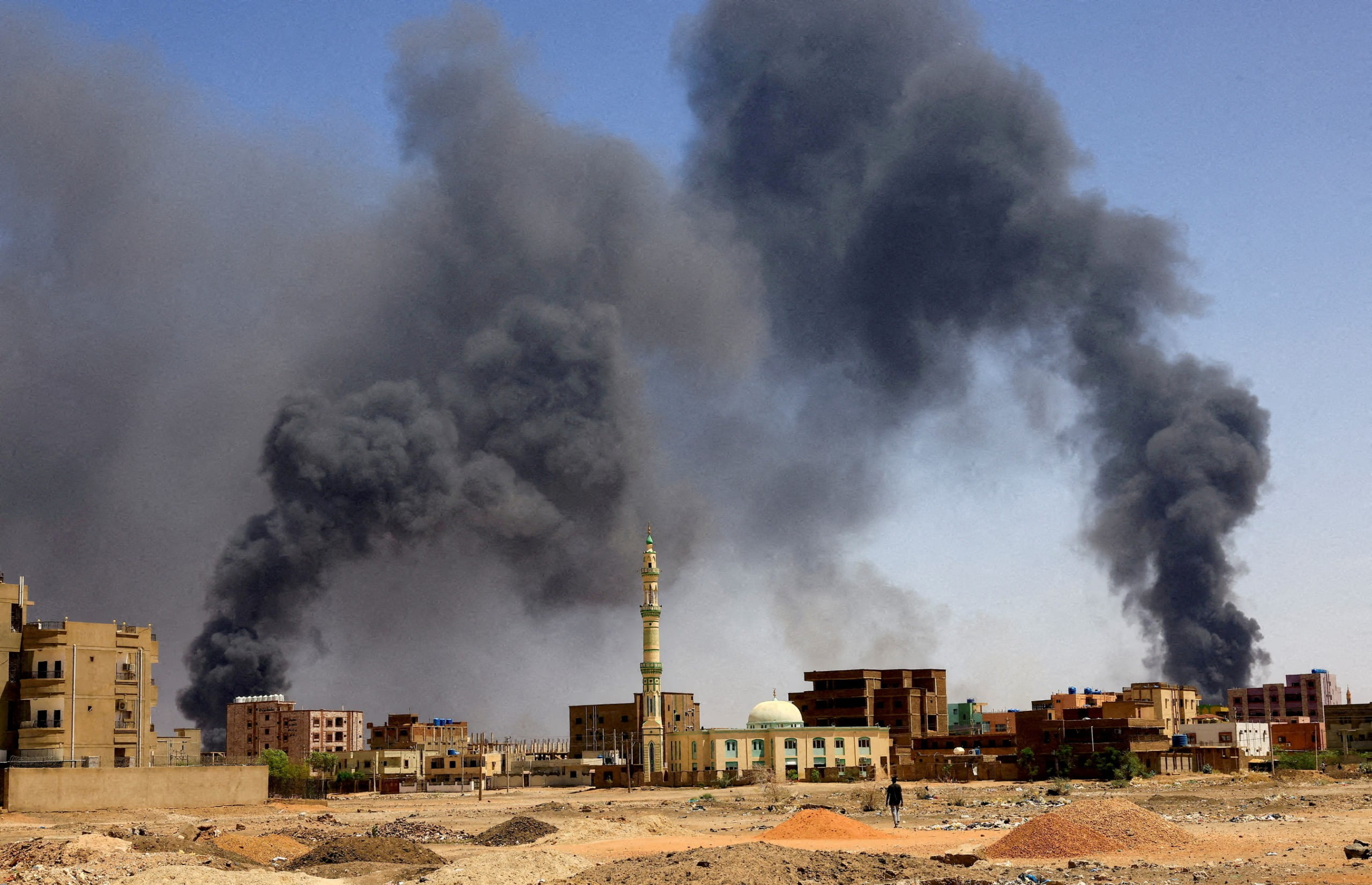
In Sudan, death no longer needs to announce itself with the thunder of advancing armies. It can arrive silently from the sky, descend upon a marketplace, and leave behind a landscape of fire, shattered buildings and families searching through the ruins for the missing.
A devastating wave of drone strikes has reportedly killed more than 200 people in Sudan and the disputed border region of Abyei, laying bare the increasingly indiscriminate horrors of a civil war that has become one of the world’s most catastrophic humanitarian emergencies.
The latest attacks, reported on 19 and 20 October, struck West Kordofan in Sudan and Amiet Market in Abyei, a strategically important, oil-rich territory claimed by both Sudan and South Sudan. What followed was a grim procession of casualties, burning fuel depots and emergency workers struggling to recover bodies from the wreckage.
In Abyei, the death toll from Monday’s attack rose to at least 153, according to local officials cited by Reuters. The market, a commercial hub serving communities on both sides of the disputed territory, was engulfed in flames after the strike hit areas near a fuel depot. Witnesses described multiple explosions and bodies bearing severe burns.
Sudan’s military was blamed by Abyei officials, while a military source told the BBC that the army had carried out the attack, claiming the target was a fuel supply site serving the paramilitary Rapid Support Forces (RSF). The precise circumstances and full civilian toll remain subject to verification.
Yet the distinction between a military objective and the lives surrounding it is precisely where modern warfare becomes morally and legally perilous. Markets are not merely coordinates on a military map. They are where people buy food, earn their living and maintain the fragile routines that survive even amid war.
The violence was not confined to Abyei. In West Kordofan, drone attacks on Sunday reportedly killed scores of people, including mourners travelling to a funeral. The Sudan War Observatory reported that a truck carrying mourners was struck near Al-Dibab, with additional casualties reported at a funeral gathering. Another strike hit a market in Al-Mujlad.
There is something particularly chilling about a funeral procession becoming another occasion for mourning. In a country already exhausted by bereavement, even the journey to bury the dead has become perilous.
Sudan’s war erupted in April 2023, when a power struggle between the Sudanese Armed Forces and the RSF descended into open conflict. Since then, the contest for political and military supremacy has devastated communities, displaced millions and helped produce one of the world’s gravest humanitarian crises.
The proliferation of armed drones has added a dangerous new dimension. Their capacity to strike distant targets allows combatants to extend the battlefield far beyond conventional front lines. A United Nations fact-finding mission reported in September that drone attacks had killed more than 1,000 people during the first five months of 2026, raising serious concerns about violations of international humanitarian law.
The consequences are now reaching across Sudan’s borders. South Sudan, which shares responsibility for administering Abyei, summoned Sudan’s ambassador following the market attack. The incident threatens to inflame an already unresolved territorial dispute dating back to South Sudan’s independence in 2011.
Meanwhile, Médecins Sans Frontières has treated wounded patients at Ameth Bek Hospital, including people with severe burns and critical injuries.
The tragedy is not simply that drones can kill so many people. It is that the technology of modern warfare has advanced while the political imagination required to end the fighting remains stubbornly inadequate.
For Sudan’s civilians, the distinction between front line and home has become increasingly meaningless. A market can become a battlefield; a funeral, a death sentence. And while commanders argue over targets, territories and military necessity, ordinary people continue to pay the most unforgiving price of a war they did not choose.