
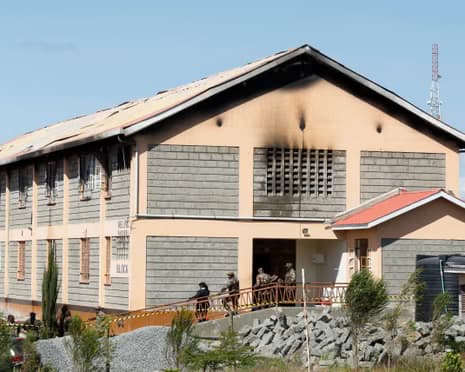
Sixteen young lives were extinguished in a school dormitory fire. Now, as two of the minors charged over the tragedy seek plea bargains, a case that began in the ashes of Utumishi Girls Academy is entering a new and delicate chapter: one in which justice must contend with grief, accountability and the complicated business of judging children.
The developments emerged at the Kibera Law Courts, where the prosecution confirmed that it had formally received a plea-bargaining request concerning one of the minors, while a second defence lawyer said he had separately approached the Office of the Director of Public Prosecutions (ODPP) seeking negotiations for his client. Preliminary discussions have begun, but further consultations are required before the process can advance.
The distinction matters. A request to negotiate is not an admission of guilt, still less a verdict. The eight minors charged in connection with the deaths pleaded not guilty when they appeared in court in July. Their identities remain protected under judicial directions, a reminder that the pursuit of justice must not become a licence to expose children to public condemnation before their cases are determined.
The tragedy itself unfolded on the night of May 27–28, 2026, at Utumishi Girls Academy in Gilgil, Nakuru County. A fire in a school dormitory killed 16 students and injured scores of others, turning an ordinary night of school life into a catastrophe whose consequences continue to reverberate through grieving families and the country’s education system.
The horror was not merely the violence of the flames. It was the sudden destruction of the ordinary futures that families entrust to schools: examinations to sit, friendships to nurture, careers to imagine and homes to return to during holidays. For the bereaved, the courtroom’s procedural language can seem a painfully inadequate response to a loss that no agreement can reverse.
Yet the law cannot be permitted to run on grief alone. The question is whether the evidence can establish individual responsibility, whether the proceedings will protect the rights of the children involved, and whether the families of those who died will receive a credible account of what happened.
Plea bargaining, a recognised mechanism under Kenyan criminal procedure, allows the prosecution and an accused person to negotiate a possible resolution of a criminal case, subject to the law and the court’s approval. In a case of this gravity, any proposed agreement must withstand scrutiny. The fact that negotiations have been initiated does not establish their eventual terms or guarantee that an agreement will be reached.
Justice Diana Kavedza has allowed discussions to proceed and directed that the parents of all eight minors receive two enhanced visits per month at Kamae Borstal Institution, where the children are being held. The additional visits are intended to facilitate consultations between the minors, their families and their legal representatives. The court also directed that the matter be mentioned every two weeks to monitor progress, with the next mention scheduled for November 11, 2026.
There is another detail that gives this case its peculiar poignancy: the children are continuing with their education in custody and are expected to sit their examinations. In one corner of this story, schoolwork continues; in another, families confront a grief that no examination result, legal agreement or judicial pronouncement can undo.
Kenya knows the terrible history of school fires. The 2001 Kyanguli Secondary School fire killed 67 boys, while the 2024 Hillside Endarasha Academy fire claimed 21 children’s lives. The Utumishi tragedy has renewed difficult questions about boarding-school safety, emergency preparedness and the institutional failures that can turn a fire into a mass-casualty disaster.
The challenge now is to resist two temptations: treating the minors as guilty before the court has reached its conclusions, and mistaking a negotiated resolution for a complete answer to the tragedy.
For the families of the 16 dead girls, justice must mean more than the conclusion of a case. It must include an honest reckoning with the circumstances of the fire, accountability established through lawful proceedings, and safeguards that make another such catastrophe less likely.
The flames at Utumishi have long since died. The legal questions they left behind have not. And as the court weighs the next steps, Kenya must confront a sobering truth: when children die in the place entrusted with their protection, the search for justice is also a test of the institutions responsible for keeping them safe.