
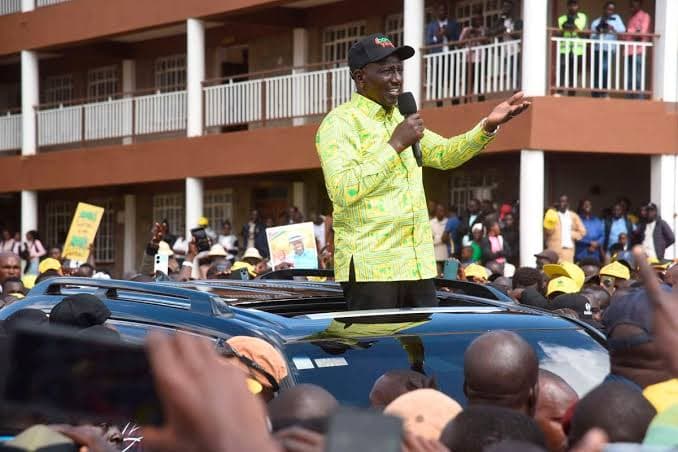
President William Ruto has returned to familiar political territory, but the stakes are no longer those of a rising politician courting a loyal constituency. As he traverses the North Rift, Kenya’s President is campaigning for his political survival, turning project launches into electoral rallies and directing some of his sharpest broadsides at the man who once helped propel him to power.
On Monday, October 12, Ruto’s tour of Nandi and Uasin Gishu counties offered a revealing preview of the 2027 presidential contest: development as campaign currency, political betrayal as rallying cry and an opposition he portrays as long on insults but desperately short of ideas.
“I’m ready to stand before Kenyans and show them the work I have done so that they can give me another chance to work,” he declared in Nandi, according to The Star. “Too much noise and calling me names will not help you.”
It is a message calculated to turn the election into a referendum on delivery rather than discontent. Ruto is asking voters to judge his administration by what it has built, subsidised and promised to complete, rather than by the grievances his critics have assembled against it.
His catalogue is expansive. In Nandi, he pointed to road construction, affordable housing, rural electrification, fertiliser subsidies and the Social Health Authority (SHA). He also invoked agricultural earnings, claiming that milk prices had risen from Sh50 to Sh70 per litre, coffee from Sh70 to Sh150 per kilogramme, and tea to Sh56 per kilogramme. These are presidential claims, not an independent assessment of how evenly households have benefited from his policies.
The electoral arithmetic is equally explicit. Ruto has challenged his North Rift supporters to deliver an additional one million votes in 2027, urging eligible residents to obtain national identity cards and register as voters. His rallying cry, “Usawa ni Sawa”, accompanied by the familiar “Kazi ni Kazi”, seeks to bind the language of equality and work to a more immediate political demand: loyalty at the ballot box.
Yet the tour has been as much about settling political scores as selling development.
The most combustible target is former president Uhuru Kenyatta, Ruto’s former political partner. Accusing Kenyatta of abandoning him after their successive electoral victories in 2013 and 2017, Ruto alleged that the two had understood that each would serve for a decade. When his own presidential moment arrived in 2022, he said, his former boss turned against him.
“You conned me,” Ruto charged, warning opposition leaders now associating with Kenyatta that they risked a similar fate. He also criticised Kenyatta’s record on the economy and education, telling him to “give us a break”.
The President has been no gentler towards his current opponents. In Nandi, he dismissed their criticism as “raw jealousy”, arguing that slogans such as “Kasongo Must Go” cannot substitute for credible policy. He insisted that even a united opposition would struggle to defeat him.
The irony is difficult to miss. A President campaigning on national unity has made the disunity of his adversaries a central weapon, while his own broad-based arrangement with ODM is presented as evidence of political maturity and national inclusion.
Whether the strategy succeeds will depend on more than the enthusiasm of roadside crowds. Roads must improve livelihoods; subsidies must reach farmers; healthcare reforms must work for patients. Political insults may electrify a rally, but they cannot settle the question confronting millions of Kenyans: whether life has become more affordable and opportunity more accessible under Ruto’s administration.
The North Rift remains a formidable political platform for the President. But in the contest ahead, a million promised votes and a thousand sharp accusations will ultimately meet the same unforgiving judge: the electorate.