
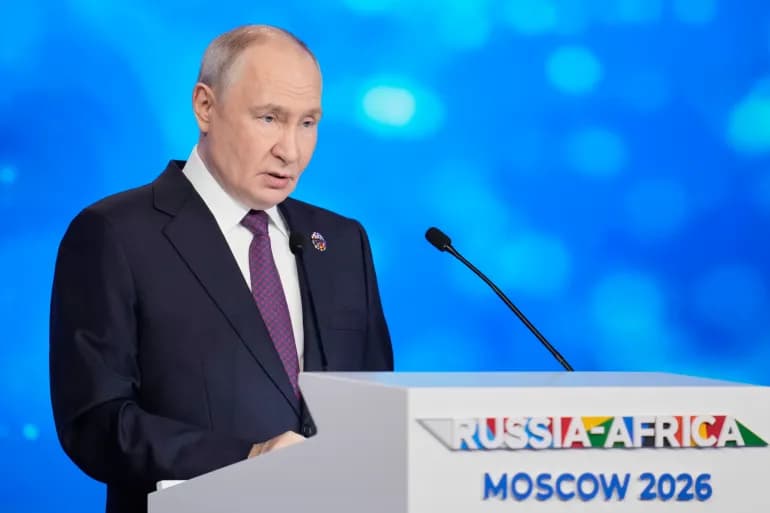
There is something wonderfully convenient about a great power discovering its conscience just when it needs new friends. On Wednesday, Vladimir Putin, Russia’s president and an accomplished student of geopolitical theatre, welcomed African leaders to Moscow with a message calculated to resonate from Dakar to Nairobi: Russia, unlike the former colonial masters of Africa, has no intention of exploiting the continent.
Addressing the third Russia-Africa Summit, Putin accused Western countries of continuing to plunder African resources and using debt to frustrate development. Russia, he insisted, offered something nobler: local processing, employment, technology transfer and a relationship between sovereign equals.
It was a persuasive performance, at least for an audience familiar with the less flattering chapters of European imperialism. The colonial powers arrived with their bibles, flags and civilising missions; the bills, naturally, were presented to the colonised. Putin’s argument is that Moscow has come with a different proposition. Whether the Kremlin’s conduct will prove as emancipatory as its rhetoric is another question.
The gathering brought together representatives from 48 African countries, including 22 heads of state, making it a substantial demonstration of Moscow’s continuing diplomatic reach. For a government under Western sanctions over its war against Ukraine, Africa is not merely a collection of prospective markets. It is a political constituency, a source of strategic partnerships and a formidable voting bloc in the United Nations.
The language of multipolarity is therefore doing useful work. Putin declared that the era in which a narrow group of countries determined the fate of entire continents was drawing to an irreversible close. The implication was unmistakable: Africa need not take instructions from Washington, Brussels or Paris when Moscow is prepared to offer another door.
And there are material incentives behind the invitation. Russia has established relationships in defence, energy, fertiliser supplies and nuclear power. Putin said Moscow had delivered 13 million metric tonnes of agricultural products to Africa during the first nine months of 2026 and was ready to expand shipments. In a world troubled by disrupted grain routes and fertiliser supplies, such offers have an appeal beyond diplomatic flattery.
Yet the romance of Russian-African solidarity comes with awkward footnotes. Moscow’s expanding security role has accompanied its courtship of military-led governments in the Sahel, where Russian personnel and security assistance have become instruments of influence. Western governments accuse Russian-backed forces of helping juntas consolidate power; Russia rejects the charge that its security partnerships amount to imperial domination.
More troubling still is the question of African citizens recruited to fight in Russia’s war against Ukraine. Amnesty International, in a briefing published in September, documented allegations that foreign nationals had been lured through deceptive job offers, coercion and exploitation of economic vulnerability. On the eve of the summit, the organisation urged African leaders to confront Putin directly over the recruitment of their citizens.
For Kenya, this is no abstract diplomatic quarrel. President William Ruto travelled to Moscow amid concern over Kenyans drawn into the Russian military. The EUobserver reported that Ruto had asked Moscow to assist in repatriating Kenyan men recruited to fight in Ukraine, with the Kremlin yet to publicly respond to the request.
Here, the rhetoric of sovereignty encounters its most uncomfortable test. If Africa’s people must be protected from the predatory ambitions of former colonial powers, they must equally be protected from exploitation by new suitors. A continent cannot be sovereign in the conference hall while its citizens are allegedly deceived into becoming expendable instruments of another country’s war.
Africa should, of course, welcome partners beyond the traditional Western orbit. It should trade with Russia, negotiate with China, maintain relations with Europe and do business with America. But strategic autonomy means something more demanding than exchanging one patron for another. It means having the institutional strength to negotiate favourable contracts, insist on technology transfer, scrutinise security agreements and reject arrangements that sacrifice citizens’ interests for elite convenience.
Putin’s promise deserves to be judged against precisely those standards. How much value will African economies retain from their natural resources? How many jobs will investment create? Will agreements be transparent, and will African governments be free to criticise Moscow when their interests diverge?
These are not unfriendly questions. They are the questions that genuine friendship ought to survive.
The Kremlin’s courtship may yet produce useful commercial and diplomatic dividends. But history has furnished Africa with enough liberation rhetoric to fill a library, and too many partnerships in which the powerful arrived bearing promises while the vulnerable paid the price.
Putin says Russia will not pursue neo-colonialism. Very well. The most convincing proof will not be another speech about Western hypocrisy, nor another photograph of presidents exchanging handshakes beneath Moscow’s chandeliers. It will be a relationship in which African countries acquire greater productive capacity, their citizens enjoy greater security, and their governments retain the freedom to say no.
For Africa, the real prize is not discovering which great power makes the most flattering declaration. It is reaching the point at which none can dictate the continent’s future.