
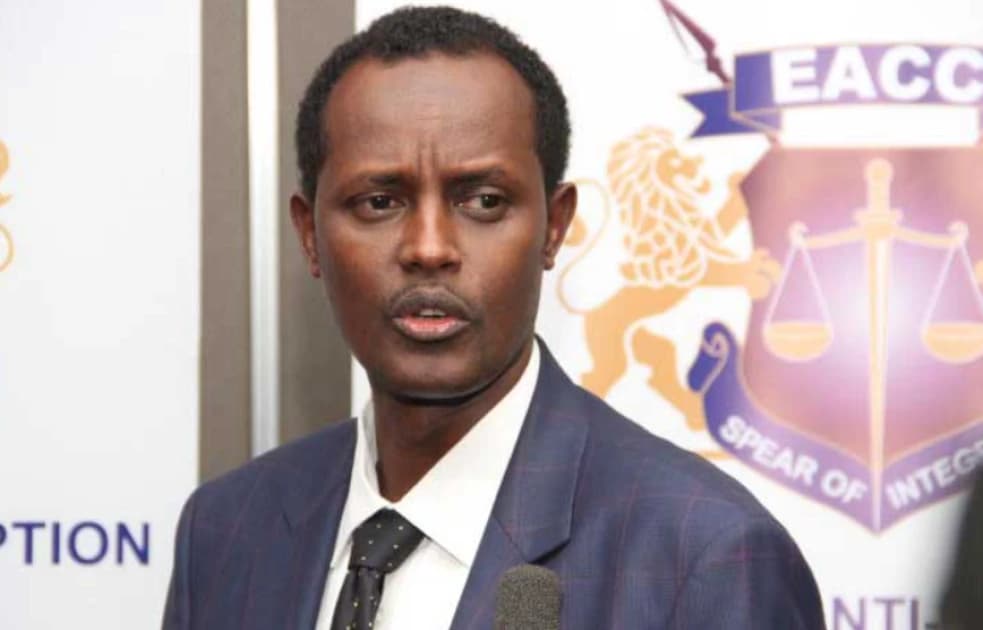
Kenya’s electoral commission is searching for a chief executive, and among the nine hopefuls is a man who once occupied the commanding heights of the country’s anti-corruption establishment. Halakhe Waqo, the former head of the Ethics and Anti-Corruption Commission (EACC), has made the shortlist for the position of Commission Secretary and Chief Executive Officer of the Independent Electoral and Boundaries Commission (IEBC), placing a seasoned public administrator in the running for one of the most consequential jobs in the country’s democratic machinery.
The shortlist, announced on October 28, emerged from a pool of 304 valid applications. Interviews are scheduled for November 12 and 13, 2026, as the IEBC seeks to fill a position left vacant by the departure of Marjan Hussein Marjan in February. The timing is hardly incidental: with the 2027 General Election approaching, the commission has little luxury for prolonged uncertainty at the top of its administrative secretariat.
Waqo is not the only heavyweight in the contest. Anthony Omerikwa, chief executive of the National Authority for the Campaign Against Alcohol and Drug Abuse (NACADA), has also secured a place on the shortlist. The remaining candidates are Harley Mutisya, Edmund Odiwuor Malitt, Andrew Gitau Kimani, Mohamed Abdullahi Abdi, Edward Katama Ngeywa, Martina Wato Yattani and Nelly Ilongo.
For Waqo, the candidacy represents a potential return to the centre of a national institution whose credibility will be tested under the harshest political scrutiny. He became the pioneering secretary and chief executive of the EACC in January 2013, following the establishment of the commission under Kenya’s post-2010 anti-corruption framework. He has also served as a commissioner at the National Cohesion and Integration Commission.
But the IEBC is not simply another government office. Its chief executive is the administrative engine behind an institution whose decisions can determine whether millions of Kenyans trust the ballot, accept the results and believe that political competition is governed by rules rather than the whims of powerful individuals.
The successful candidate will oversee the commission’s day-to-day operations, manage budgets and procurement, supervise secretariat staff and coordinate the administrative work required for elections, referenda and continuous voter registration. The position carries a four-year term, renewable subject to performance.
The recruitment also comes after a turbulent succession. Marjan, who had served as acting chief executive for years before assuming the substantive position in 2022, resigned on February 3, 2026. His departure followed questions about governance and management at the commission, including procurement and personnel matters. The subsequent acting appointments have underscored the importance of securing stable administrative leadership before the next general election.
The IEBC says its selection process has considered merit, gender, regional balance and the inclusion of persons with disabilities. Candidates must produce their original academic and professional credentials and clearances from the EACC, Directorate of Criminal Investigations, Kenya Revenue Authority, Higher Education Loans Board and a registered credit reference bureau. The commission has warned that canvassing will result in automatic disqualification.
These safeguards matter. An electoral commission must be able to demonstrate not only that it follows the law, but that its internal decisions are transparent enough to inspire public confidence. The chief executive will not independently determine the political outcome of an election, but the competence of the secretariat can influence the effectiveness of voter registration, logistics, technology and the administration of the vote.
Waqo’s experience may count in his favour. Yet a distinguished résumé is not a substitute for a credible selection process, just as an appointment cannot, by itself, restore public confidence in an institution.
The contest is therefore about more than who occupies an office in Anniversary Towers. It is about who will help prepare Kenya’s electoral machinery for 2027, when the IEBC will once again face the enormous responsibility of administering a fiercely contested democratic exercise.
Waqo has reached the shortlist, not the finish line. The interviews will determine the next step. The greater test, whoever wins, will be to ensure that when Kenyans finally queue to vote, the machinery behind their choices is ready, impartial and worthy of their trust.