
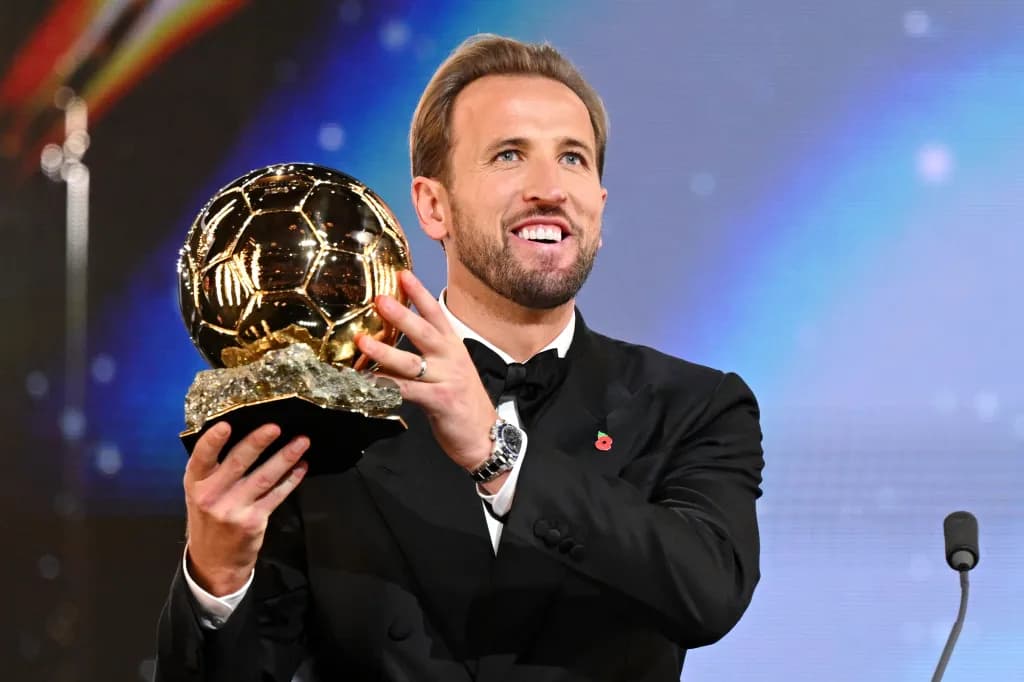
Football is a cruel accountant. It keeps immaculate records of every goal scored, every final lost and every trophy left tantalisingly beyond reach. For years, Harry Kane supplied the goals while the honours went elsewhere, becoming the most accomplished striker of his generation to carry the peculiar burden of being considered incomplete. On Monday night, at a ceremony in London, the ledger was finally balanced. The Bayern Munich forward won the 2026 Ballon d’Or, becoming the first Englishman since Michael Owen in 2001 to claim football’s most prestigious individual award.
At 33, Kane has arrived at the summit by a route that offers little comfort to those who believe sporting greatness is a matter of destiny. His career began with rejection: Arsenal released him from their academy as a boy, apparently failing to recognise the potential of a player who would eventually become one of Europe’s most feared finishers. His subsequent development was hardly the stuff of footballing fairy tales. Loan spells at Leyton Orient, Millwall, Norwich City and Leicester City demanded patience, resilience and the willingness to establish himself far from the spotlight. Kane was not anointed a superstar. He had to become one.
At Tottenham Hotspur, he transformed promise into a formidable record, scoring 280 goals in all competitions and winning the Premier League Golden Boot three times. Yet the silverware cabinet remained stubbornly unimpressed. Tottenham lost the 2019 Champions League final to Liverpool, while England suffered defeats in the Euro 2020 and Euro 2024 finals. Kane could conquer defences, but the ultimate prizes seemed to possess a private arrangement with everybody else. His reputation became a footballing paradox: a striker whose individual brilliance was indisputable, yet whose career was persistently measured against the trophies he had not won.
His move to Bayern Munich in 2023 was an attempt to escape that contradiction. The German giants offered a club accustomed to winning, a formidable supporting cast and the prospect of finally turning goals into medals. The first season ended without a major trophy, prompting the predictable jokes about Kane’s supposed curse. But the following campaign began to rewrite the narrative. Bayern reclaimed the Bundesliga title in 2024-25, and Kane’s subsequent season delivered the kind of numbers that make even the most sceptical observer reach for a calculator.
He scored 61 goals in 51 appearances for Bayern during 2025-26, a club record, and added 12 goals for England, taking his tally to 73 in 65 matches. His 36 Bundesliga goals made him the league’s leading scorer, while 14 strikes in the Champions League underlined his ability to deliver against Europe’s elite. He also scored ten times in the German Cup, including a hat-trick in the final against Stuttgart, as Bayern secured the domestic double. These were not merely impressive statistics. They were an argument for excellence delivered with such force that the voting journalists could scarcely ignore it.
The competition was formidable. Real Madrid’s Kylian Mbappé finished second, with Barcelona’s Lamine Yamal third. Yamal represented football’s intoxicating promise of youth; Mbappé, the familiar glamour of a global superstar. Kane offered something different: the triumph of accumulation, the reward for a player who had refined his craft until consistency became almost unreasonable. His victory also carried historical weight. He became only the fifth Englishman to win the award, joining Stanley Matthews, Bobby Charlton, Kevin Keegan and Owen.
There is an irony, too, in the fact that Kane won despite Bayern’s Champions League semi-final exit and England’s failure to win the World Cup. The Ballon d’Or has often favoured players whose seasons culminate in the grandest collective triumphs. Kane’s victory suggests that extraordinary individual performance can still prevail when the most coveted team prizes remain elusive. It is a rare distinction, and a reminder that football’s history is not written by trophies alone.
Speaking after his triumph, Kane reflected on the doubts that had accompanied his rise, admitting that he had not always been regarded as a future superstar. He spoke of self-belief, determination and the struggle to overcome his own doubts. Such sentiments can sound suspiciously rehearsed at award ceremonies, but in his case they possess the authority of experience. Kane has spent years being told, implicitly or otherwise, that something was missing. Now, at last, he has an answer.
The Ballon d’Or cannot erase every disappointment, nor does it guarantee another trophy. But it changes the terms of the argument. Kane is no longer merely the great striker who could not win enough. He is the Englishman who conquered football’s most prestigious individual honour through sheer force of performance. Arsenal once decided he was not good enough. On Monday night, the rejected boy became the golden man, and football’s long memory delivered its most satisfying irony.